Posts

Beyond JSON – Alternates

 Previous - Beyond JSON – The Dominance When you want to write data to a file or send it over the network, you have to encode it as some kind of self-contained sequence of bytes (for example, a JSON document). Since a pointer would not make sense to any other process, this sequence-of-bytes representation looks quite different from the data structures that are normally used in memory. Thus, we need some kind of translation between the two representations. The translation from the in-memory representation to a byte sequence is called encoding (also known as serialization or marshalling), and the reverse is called decoding (parsing, deserialization, unmarshalling). Most of the programing languages have built in encoding libraries for encoding in-memory objects (JAVA:java.io.serializable, Ruby:Marshal etc.). But the issue with them is that the encoding is language specific. It’s generally a bad idea to use your language’s built-in encoding for anything other than very transient purpos...
Beyond JSON – The Dominance

Image
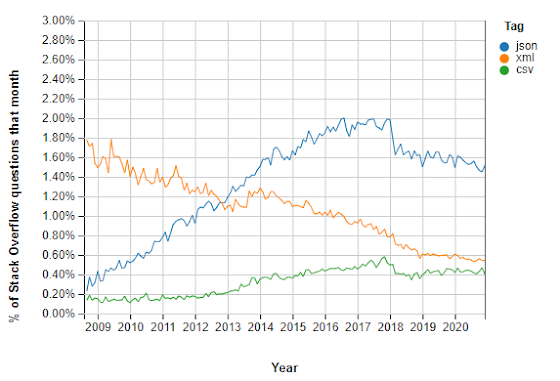
 Previous - Beyond JSON - The Emergence By 2010, there were many JSON parsing libraries available and JSON kept gaining the popularity amongst data exchange formats. As the below graph clearly shows that JSON surpassed the popularity of XML by around 2012. The big push came with the adoption of REST architectural style along with the AJAX based frameworks like Ruby on Rails. The JavaScript  frameworks like Angular (courtesy Google in 2009) and React (courtesy Facebook 2013) acted as the catalyst to the acceptance and adoption of JSON as natural choice for data exchange. As the UI frameworks are so JavaScript heavy that JSON did fit the paradigm very well. We have been able to manage the user experience through the UI reactive frameworks. Also, one of the important consideration was the testability of JSON data dependent UI. Designers / Front End developer can independently test UI with a high level of accuracy JSON being a human readable, text based data format. Below reason...

Beyond JSON - The Emergence

Image
  Previous -  Beyond JSON - Flashback In late nineties, there was a greater push to keep finding the technology for the distributed systems. The biggest challenge was the data exchange between the systems.  There is something happening in parallel. The emergence of WWW . In 1989, Tim Berners-Lee wrote a memo proposing an Internet-based hypertext system. Berners-Lee specified HTML and wrote the browser and server software in late 1990. Browsers became the interpreters for the HTML and we saw the success one of the first truly intended distributed system with runtime interpretation in as early as 1990. Soon people started analyzing the possibility of HTML as the data exchange format. This led to the revolution of emergence of XML . It was about to change the way we think about the distributed systems. Everyone was sure about the success and there was a need to standardize the specifications for cross platform and application data exchange. XML 1.0 specifications came around...

Beyond JSON - Flashback

Image
A Short Story In the world where even services are becoming micro, I thought of writing a micro story. I cannot cover it in one blog so dividing it in multiple bogs as below; 1. Flashback 2. Emergence 3.  Dominance 4.  Alternates The trigger point of this article is the unquestionable dominant usage of JSON. You are looked upon with suspicion if you try proposing to even evaluate an alternate. I have been amazed with the faith in JSON we have put in many architectural solutions. There are definitely valid reasons for the faith in JSON but I feel we should always have our reasons for doing so. In this series, I have tried to identify the reasons of emergence and reasons to alternates. Before the need and emergence of the distributed systems, we were only interacting the APIs in the same memory space (The realistic Monolithic apps, not what we say in today’s vocabulary to justify and define Micro services). With the advent of distributed applications, we started delving into mec...

How to terminate application running in background

At times an application do not stop properly and keep running in background, occupying  port. Step 1: Identify the TCP process id binding to a specific port $>netstat -ano | find "8080" TCP 0.0.0.0:8080 0.0.0.0:0 LISTENING 28268 TCP [::]:8080 [::]:0 LISTENING 28268 Step 2: Kill the process $>taskkill /F /PID 28268

BeanDefinitionStoreException: Failed to parse configuration class: Could not find class [javax.jms.ConnectionFactory]

If you are creating a Spring Boot application and see the following error stack . ____ _ __ _ _ /\\ / ___'_ __ _ _(_)_ __ __ _ \ \ \ \ ( ( )\___ | '_ | '_| | '_ \/ _` | \ \ \ \ \\/ ___)| |_)| | | | | || (_| | ) ) ) ) ' |____| .__|_| |_|_| |_\__, | / / / / =========|_|==============|___/=/_/_/_/ :: Spring Boot :: (v2.2.0.RELEASE) 2020-06-27 19:30:32.786 INFO 35224 --- [ main] SchoolApplication : Starting SchoolApplication on LTUS76179 with PID 35224 (C:\personal\eclipse-workspace\apievolution\target\classes started by 381548 in C:\personal\eclipse-workspace\apievolution) 2020-06-27 19:30:32.796 INFO 35224 --- [ main] SchoolApplication : No active profile set, falling back to default profiles: default 2020-06-27 19:30:32.964 WARN 35224 --- [ main] ionWarningsApplicationContextInitializer : ** WARNING ** : Your ApplicationContext is unli...

Cloud Enabled Scalability – My Story

Image
Something prompted me to blog again after a long time and not sure if I would be motivated to continue. First, I thought to share a long pending experience, which I had the opportunity to have eight years back. The best weapon we have with the rise of Cloud is on demand scalability (my reference is of 8 years back which everyone knows now). Most of the times when we talk about cloud, we are not talking enabling application for cloud adoption but only talk about cloud infrastructure management (which is sad). I am going to talk about my experience in making an application cloud enable and the use of the design principles. As I am talking an experience gained 8 years back (I am a bit rusty now) I will go through the journey with the case study. Thats How it Started So our story start back in 2011 when hero Mr Dan came up with an idea to monetize the online imagery content of advertisement and make some money (back then it was a cool idea, Google was doin...